
SUPPORT OUR WORK →
WHAT’S COMING NEXT? →
TAKE OUR SURVEY →
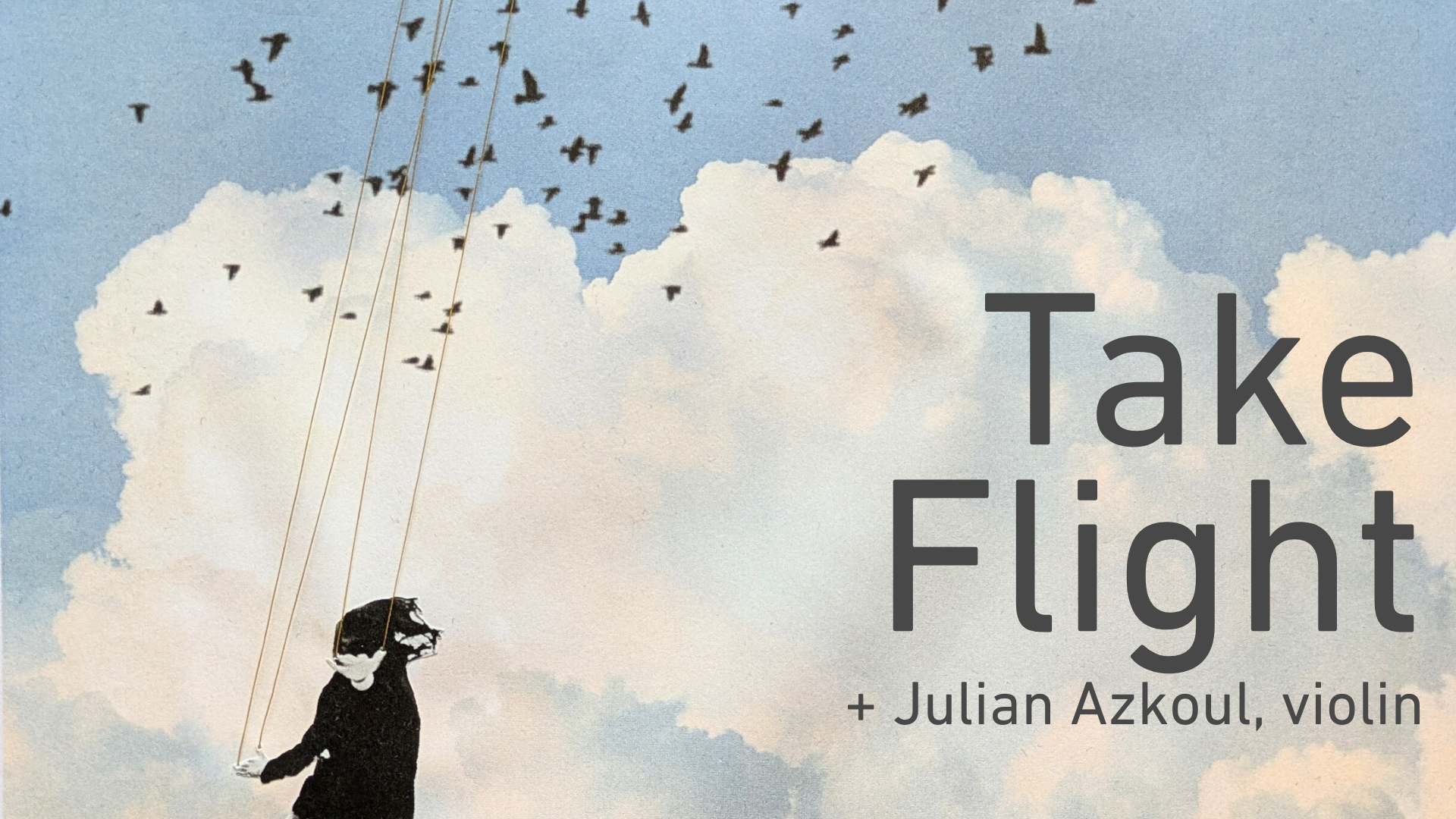
Take flight
PROGRAMME
Yukiko Nishimura In The Wind 1. Land Breeze
Christopher Tin Hope is the Thing with Feathers
Owain Park The Wings of the Wind
Yukiko Nishimura In The Wind 2. Gray Sky
Caroline Shaw and the swallow
Anna Clyne Orbits
Yukiko Nishimura In The Wind 3. Breath of Air
Charles Villiers Stanford The Blue Bird
Eric Whitacre Leonardo Dreams of His Flying Machine
Yukiko Nishimura In The Wind 4. High Wind
Claire Victoria Roberts Hope is the Thing with Feathers
Ralph Vaughan Williams arr. Paul Drayton The Lark Ascending
-
Conductor Ellie Slorach
Violin Julian Azkoul
Programme Notes
Born in Japan but based in America, composer Yukiko Nishimura has been seeking inspiration from nature for the majority of her thirty-year composition career. In The Wind, for solo violin, is cast in four movements: Land Breeze, Gray Sky, Breath of Air, and High Wind, heard at various junctions of the Take Flight programme. After an opening, rhapsodic statement, Gray Sky deals with faster, loopier passages. Breath of Air turns that energy inwards in a moment of introspective calm; High Wind finds a fizzing energy to close. Nishimura finds a lyrical style reminiscent of Vaughan Williams in his Lark Ascending, combined with some of the brilliant flashes of prolific composers for solo violin like Eugene Ysaÿe.
Beginning with lush, wordless lines (echoing the “tune without words” mentioned in the opening stanza), Christopher Tin’s setting of Emily Dickinson’s most famous poem “Hope” is the thing with feathers stresses hope’s lush, redemptive qualities. The piece began life as another bird-themed piece: a string orchestra composition called Flocks a Mile Wide, for a documentary called The Lost Bird Project. Tin describes the setting as “a meditation on the fragility of nature, as well as our hand in its destruction.” It’s elegiac and warm.
Take Flight revels in both the literal experience of flight, and as something more metaphoric. and the swallow, by Caroline Shaw, opts for the latter. It sets Psalm 84; written in 2017, it’s one of a number of Shaw’s works from the period to address the refugee crisis through traditional texts. As she composed the work, Shaw was moved to set the psalm’s central line: “The sparrow found a house and the swallow her nest, where she may place her young.” It features many gestures we now associate with Shaw’s musical styles: the glowing major harmonies shifting in parallel thirds, and the vocal utterances that trickle and shimmer.
Metaphors abound in the poem I Live My Life in Growing Orbits by Rainer Maria Rilke. The speaker circles around God for a thousand years, moving in large and growing orbits, all the while questioning who she really is: is she “a falcon, or a storm, or a great song?” she asks. Anna Clyne captures some of that upbeat curiosity in her bright, rhythmic piece Orbits for choir and violin soloist, written for The Sixteen and premiered in 2025.
Charles Villiers Stanford is best known today for his contributions to Anglican church music, both in his own popular sets of canticles, and for the example he provided for composers like Henry Brewer, George Dyson, and Herbert Howells to succeed in that genre. The other regularly performed Stanford piece is his partsong The Blue Bird, one of the most remarkably atmospheric settings in the choral canon. He sets a poem by Mary Coleridge, a relative of Samuel Taylor Coleridge, the poet remembered for epic poems like The Rime of the Ancient Mariner. Her text has an enchanting, vaguely mystical quality, as a bird momentarily flashes by against a monochromatic background.
When Eric Whitacre and his longtime librettist Charles Anthony Silvestri sat down to work on a work for the 2001 Raymond W. Brock memorial commission, they began with a simple concept: what would it sound like if Leonardo Da Vinci were dreaming? The result is a piece that imagines Da Vinci dreaming of the flying machines he would design but never conquer, Whitacre’s Leonardo Dreams of His Flying Machine is a composite of musical styles which Whitacre flits quickly between. There are shades of Renaissance-style cascading polyphone, stinging clusters, and Whitacre’s trademark close harmony. It’s a notably dramatic work within Whitacre’s oeuvre, aided by its composite text; its narrator speaks in English, but the characters dream in Italian.
Claire Victoria Roberts is a composer who trained in Manchester before moving to Barcelona. She writes music in a variety of settings, across folk, chanson, classical composition, and jazz. In contrast to Tin’s setting of Dickinson, Roberts’s reading of Hope is altogether darker, with punchier rhythms and murkier harmonies. The central theme prevails, however—at the close, all extraneous music falls away to leave flashes of hope.
Of all the pieces in the classical repertoire inspired by birds, The Lark Ascending by Ralph Vaughan Williams is by far the most popular, regularly topping the Classic FM Hall of Fame and appearing on concert programmes up and down the land. When she plays it, the violinist Jennifer Pike likes to imagine “the very simple concept of a bird flying free, soaring into limitless space”—the violin soars in such a serene way as to conjure a sense of astral travelling.
Paul Drayton arranged this work in 2019 for violin and mixed choir, rather than instrumental accompaniment. Drayton wrote in his introductory notes that Vaughan Williams’ pragmatic work to champion musical inclusivity—he was a lusty supporter of brass bands and amateur choral music—was an inspiration for this novel arrangement.
Unusual it may be, but it’s not without precedent for Vaughan Williams. Later in his career, he wrote the suite for solo viola, small chorus and small orchestra Flos Campi, a work between genres, that features a prominent viola soloist and wordless choir. Here, the original poem by George Meredith (quoted at the head of Vaughan Williams’ score) is set sparingly by Drayton, with a mixture of vocal solos and wordless singing helping to preserve Vaughan Williams’ cool, clear world of lyrical expansion and quiet interiority.
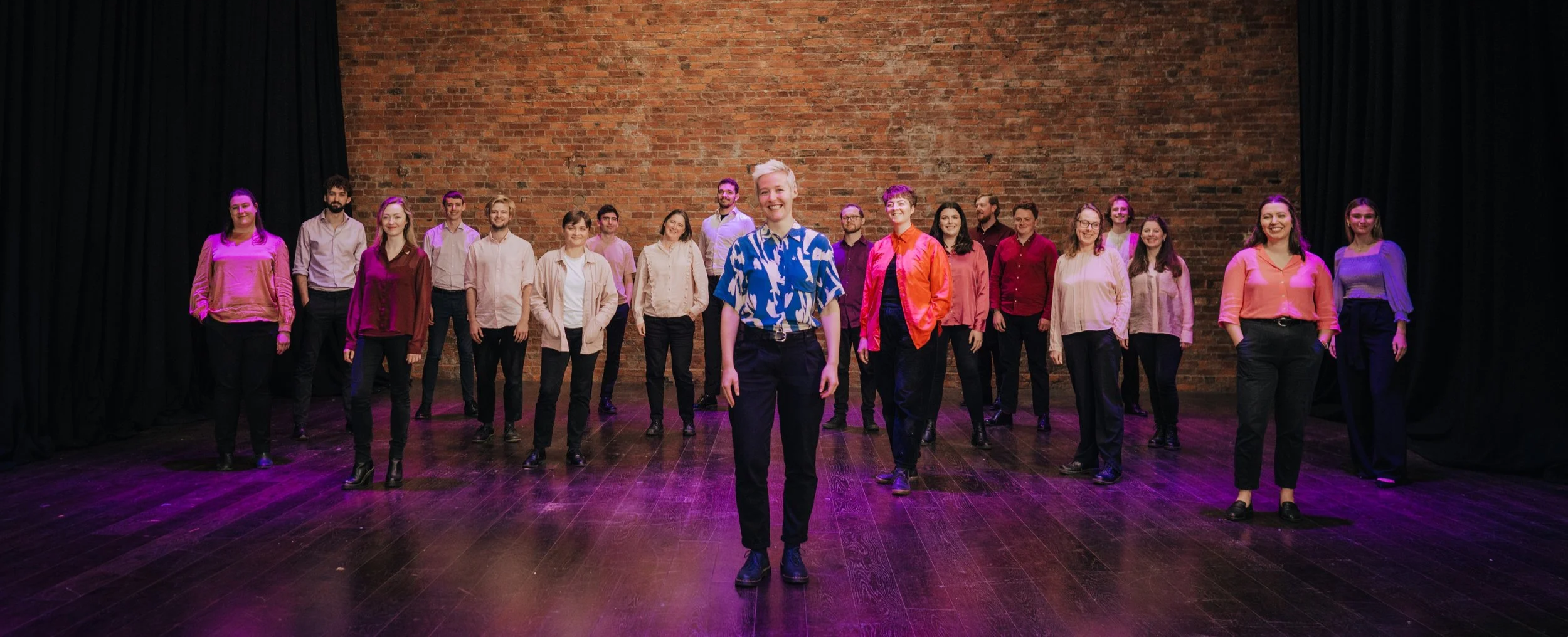
THE cHOIR
SOPRANO
Emily Ampt*
Eleonore Cockerham
Sarah Keirle-Dos Santos
Elspeth Piggott
Dominique Saulnier
ALTO
Louise Ashdown
Toluwani Idowu
Rachel Singer
Lucy Vallis
TENOR
Joseph Martin
Timothy Peters
James Savage-Hanford
Joseph Taylor
BASS
Jonny Hill
Harry Mobbs
Stuart O’Hara
Alex Peart*
Edmund Phillips
*Singers on the Royal Nothern College of Music Professional Experience Scheme
THE TEAM
Company Director Claire Shercliff
Creative Director Ellie Slorach
Production Manager Adam Critchlow
Communications & Audience Officer Ailsa Burns
Development Consultant Laurenne Chapman
Take two minutes to fill in our audience survey:
TAKE FLIGHT would not be possible without our supporters. Find out more about our supporters and how you can get involved with supporting Kantos too:
Double-click to edit...