SUPPORT OUR WORK →
WHAT’S COMING NEXT? →
TAKE OUR SURVEY →
hope on earth
PROGRAMME
Aaron Copland In the Beginning
Marvin Gaye arr. Rollo Dilworth What’s Going On
Meredith Monk Earth Seen From Above
Bob Dylan arr. Liv Muir Blowin’ in the Wind
Arnold Schoenberg Friede auf Erden
Sam Cooke arr. Charlie Perry A Change is Gonna Come
Thomas Tallis Spem in alium
Thiele & Weiss arr. Peter Hicks What A Wonderful World
-
Conductor Ellie Slorach
Programme Notes
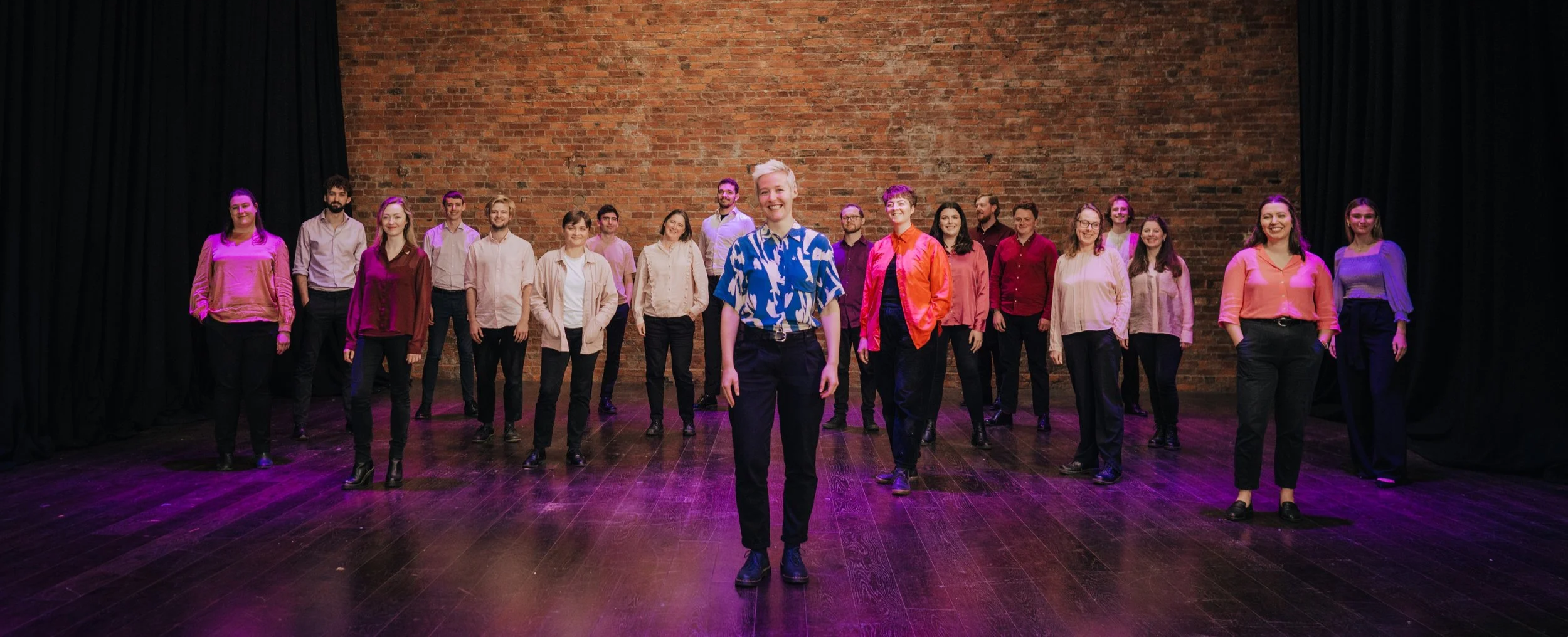
Kantos Chamber Choir celebrates ten years of boundary-pushing choral music in the north of England with songs of protest, change and hope.
Aaron Copland’s relationship with faith is fascinatingly knotty. Though born into a conservative Jewish family of Lithuanian immigrants in Brooklyn, Copland never practiced or observed religion. Musically, much of Copland’s music feels almost deliberately secular, seeking, through works like Fanfare for the Common Man and Rodeo, a vernacular American classical language without deferring to sacred signifiers. Yet, when invited by the Harvard Symposium on Music Criticism to write a work for their 1947 conference, Copland chose to set the most famous Bible passage of all: the creation story, as told in the King James version.
In The Beginning, for mezzo soloist (Lorna Day) and chorus, came in a fruitful period for Copland, following Appalachian Spring and the Third Symphony, and preceding the Clarinet Concerto, three works that would cement Copland’s reputation as “the dean of American Music.” Copland navigated through the seven days in “a gentle narrative style,” though there are dramatic flashpoints when Copland moves to the extremes of the choral instrument. (Is the relationship between declamatory soloist and chanting, breathy chorus, that of a cantor and a congregation? Perhaps). Vital rhythmic energy, dramatic tonal shifts, tonalities glued together then prised apart: All we love of Copland is found here.
Copland’s seventh day appears, radiant, as God becomes a living soul in imperious E flat major. In the aftermath, we’re left asking What’s Going On? The cheerful, chattering voices you hear at the start of the Marvin Gaye classic are actually two NFL stars Mel Farr and Lem Barney, reimagined here in busy murmurs from the choir. In an arrangement by Rollo Dilworth, What’s Going On quickly becomes a more existentially probing question. Gaye’s message of questioning power is timeless, though lines like “we’ve got to find a way / to bring some love in here today” have rarely felt so profound.
Marvin Gaye encourages us to see the bigger picture. In Earth Seen From Above, Meredith Monk finds a way of zooming out completely. Monk, legendary for her artistic shapeshifting, is known for the extensive exploration—and indeed popularisation—of vocal techniques without words. Taken from her multi-form work Ringing Place from 1987, Earth Seen From Above involves singers passing vocalisations around in a circle. Listen for the slow passage of sound around the space. Time slows in the presence of Monk’s music, making every event—a new voice, a new harmony, a shift in tonality—feel like a shifting tectonic.
Liv Muir is a music director and conductor based in the north of England. They’re also a fantastic translator of pop tunes into choral music, all showcased on Instagram in fun, bright score follower videos. They contribute their first arrangement for Kantos, of Bob Dylan’s Blowin’ in the Wind, another moment where a bright, breezy sound obscures some fairly heavy existential wondering.
The Great War tore apart a generation of artists. Composers like Enrique Granados and George Butterworth died in battle. Others like Maurice Ravel and Ralph Vaughan Williams, served their country and survived, their later art permanently scarred by the experience of war. Though conscripted, Arnold Schoenberg never saw combat, though he experienced a fundamental shift in perception. Schoenberg seems like a character from the Larkin poem: ‘‘never such innocence, never the same again.”
By 1923, Schoenberg wrote that Friede Auf Erden, from 1907, was “an illusion created in my previous innocence.” Its subject—Peace on Earth—reflects a paradise he’d later reject: idealistic, hopeful, utopian, secular. It remains, however, a landmark moment of stylistic metamorphosis for Schoenberg, moving from late Romanticism towards his later form of atonal expressionism, and a monumental work for choir, where hope and anxiety about the future are locked in an intense, anguished battle.
For ten years, Kantos have proudly presented choral masterpieces in the same space as classic pop songs, though framing Schoenberg with Bob Dylan and Sam Cooke’s A Change is Gonna Come is perhaps the boldest contrast yet. To truly resist is to stick in the battle until the change happens; Cooke’s Change is an ode to picking oneself up and going again.
Nobody is really sure why Thomas Tallis chose to write his Spem in alium, or why he chose 40 voice parts. Perhaps he was challenged by Alessandro Striggio, who was in London in 1567, having recently completed his own 40-voice motet, Ecce beatem lucem.
What Tallis created is a perfect blend of detailed polyphony, punctuated by weighty unison textures. Spem in alium, Latin for “hope in any other,” is a responsory text about putting faith in a God who can forgive all sins. Performed in the round, there are few more rousing moments in choral music than the two bold moments the choir sings “respice humilitatem nostram”: Regard our humility. The first time it’s bellowed, as a plea; the second drifts in quietly, as if absolved.
Peter Hicks’s arrangement of the Thiele & Weiss classic What A Wonderful World emerges from this transformed moment, into a pace of reflective joy. On that note, we invite you to join Kantos in the peace garden after the concert to toast our tenth anniversary!
kantos Chamber cHOIR
SOPRANO
Emily Brown Gibson
Rebecca Hardwick
Felicity Hayward
Sarah Keirle-Dos Santos
Elspeth Piggott
Cressida Sharp
ALTO
Jessica Conway
Lorna Day
Toluwani Idowu
Lucy Vallis
TENOR
Will Anderson
Alistair Donaghue
Matt Pope
Louis de Satgé
BASS
James Connolly
Sam Gilliatt
Jonny Hill
Harry Mobbs
Edmund Phillips
Henry Saywell
David Valsamidis
Royal northern college of music Chamber cHOIR
Director of Royal Northern College of Music Chamber Choir Stuart Overington
SOPRANO
Emily Ampt
Ivy Blackmoor
Charlotte Dear
Katie Shepperdson
Omara Silvester
Shyen Yii Loh
ALTO
Tilly Crutchley
Ruby Donnelly
Nia Edwards
Kamea Nemeth
Heledd Richardson
TENOR
Oli Barber
Arhan Kumar
Oliver Mollett
Liam Ormiston
Colm Traynor-Bucknall
BASS
Oscar Fairclough
Alex Peart
Alex Rouault
Colin Wu
Alex Yehorychev
university of manchester Chamber cHOIR
Director of University of Manchester Chamber Choir Tom Newall
SOPRANO
Isobel Gollings
Sophia Janahi
Niamh Mullaney
Lauren Spooner
Fenella Todd
ALTO
Stella Vollum
TENOR
Mykola Maleikyi
BASS
Jonny Barber
Daniel Garvin
Christian Traynor-Bucknall
THE TEAM
Company Director Claire Shercliff
Creative Director Ellie Slorach
Production Manager Adam Critchlow
Communications & Audience Officer Ailsa Burns
Development Consultant Laurenne Chapman
Take two minutes to fill in our audience survey:
HOPE ON EARTH would not be possible without our supporters. Find out more about our supporters and how you can get involved with supporting Kantos too: